
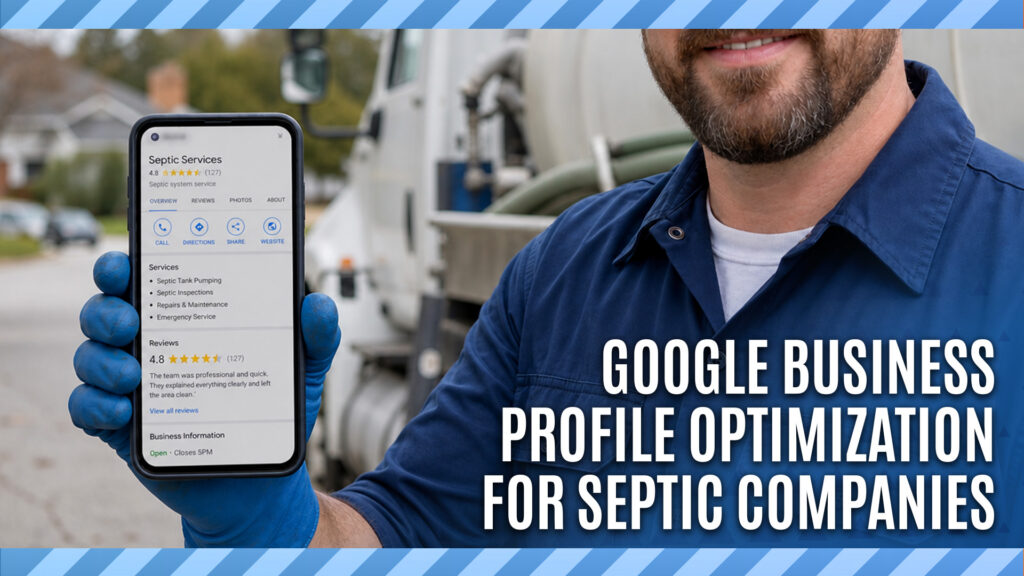
A lot of septic companies have a Google Business Profile. Far fewer are showing nearby customers the best version of their business.
Your profile might be verified and visible, and still leave customers with questions. They might not know which services you offer, whether you serve their area, how to reach you, or whether your company’s even still active.
That matters because septic customers usually search with a specific problem in mind: pumping, an inspection, a repair, maintenance, or a full system installation. They want help fast, and odds are they’re comparing you against a few other companies at the same time.
Google Business Profile optimization for septic companies is really about making that decision easier for them. Your profile should give customers, and Google, a clear, accurate picture of what you do, where you work, and why they should call you instead of the next name on the list.
What Should an Optimized Google Business Profile Accomplish?
A strong profile should answer a few basic questions before a customer ever has to dig for the information themselves:
- Does this company offer the septic service I need?
- Does it serve my location?
- Is the business open?
- Can I trust it?
- How do I call or learn more?
Your profile can help with local visibility, but it’s not a shortcut, and it won’t guarantee you rank first. Google’s weighing a handful of factors when it decides who shows up in local results.
The real goal here is making your profile as relevant, accurate, and useful as you can. That helps Google understand your business, and it gives customers more confidence once they find you.
Choose the Most Accurate Business Category
Your business category tells Google what kind of company you run.
Pick the category that most accurately describes your main line of work. If most of your business comes from septic pumping, inspections, repairs, or installation, your primary category should reflect that.
You can usually add secondary categories for other services you genuinely provide too. Just don’t tack on unrelated categories hoping to show up for more searches. That tends to create confusion instead of helping you.
Here’s a simple gut check: if a customer only saw your primary category, would they understand what your business mainly does?
For example, a septic company that picks “General Contractor” as its primary category is telling Google it’s a broad construction business, not a septic specialist, and it’ll miss out on searches from people specifically looking for septic help. “Septic System Service” is the accurate primary category for most septic companies, with something like “Plumber” or “Drainage Service” added as a secondary if it applies.
Google’s category options change over time. Double-check yours instead of assuming whatever you picked years ago is still the right fit.
Add the Septic Services You Offer
Your profile should clearly list what your company provides. Depending on the business, that may include:
- Septic tank pumping
- Septic inspections
- Septic system repairs
- Septic system installation
- Septic maintenance
- Septic tank replacement
- Riser installation
- Advanced treatment systems
- Emergency septic service
Only add services you perform.
Customers don’t always know the exact name of what they need. Someone dealing with a backup might have no idea whether the fix is pumping, a repair, or a full replacement. Clear service names and short, plain descriptions help them figure out if you’re even the right fit.
Skip the technical jargon homeowners won’t recognize. Use the words customers search for and think in, while still describing the work accurately.
Set Up Your Service Areas Honestly
Most septic companies are service-area businesses. Customers don’t usually come to your office. You go to them.
Your profile should reflect the areas you genuinely serve. List the cities, towns, or counties where your team regularly takes jobs. Don’t pad your service area just because you’d technically drive there for the right project. Keep it matched to how the business operates.
If you don’t operate out of a storefront customers visit, make sure your profile’s set up correctly as a service-area business. And don’t create a separate profile for every town you touch unless each one’s a real, staffed location that qualifies for its own listing. A single septic company running jobs across five surrounding counties from one office still only needs one profile. A second profile only makes sense if you’ve got a genuinely separate, staffed branch with its own crew and phone line in another town.
Keep Your Business Information Accurate
Basic info is easy to overlook, but it’s exactly what decides whether someone calls. Take a fresh look at your business name, phone number, website address, regular hours, holiday hours, business description, and service information.
Your business name should match what customers see on your trucks, invoices, and website. Don’t tack on extra keywords or city names unless they’re genuinely part of your company’s registered name. That’s a direct violation of Google’s guidelines for representing your business, and it’s a common reason listings get suspended.
For example, “Jones Septic Service, Best Septic Pumping Jefferson City” is a stuffed name that breaks Google’s rules. “Jones Septic Service” is what belongs on the profile, since that’s the name on the trucks, the invoices, and the sign out front.
Make sure your phone number reaches someone who can help. A polished profile won’t matter much if calls go unanswered, and a profile still listing an old office line while your team dispatches from a new number means some calls simply never reach you.
Update your hours around holidays, weather, or seasonal changes. A customer who calls based on wrong hours will usually just move on to the next company instead of calling back later.
Use Real Photos That Build Confidence
Photos tell customers your business is active, professional, and real. Useful photos for a septic company might include branded trucks, team members, pumping and inspection equipment, completed projects, safe job-site shots, your office or shop exterior, and employees in branded uniforms.
You don’t need professional photography for every update. Clear, current photos of real work usually do more for you than polished stock images.
Skip anything graphic or unpleasant that might make customers uncomfortable. The goal’s showing professionalism, your equipment, and the kind of work your team handles.
For example, a dark, blurry photo of a truck snapped in a parking lot at night does a lot less for you than a clear daytime shot of that same truck with your logo visible. The photo doesn’t need to be professionally shot. It just needs to be clear, well-lit, and recognizably yours.
Build a Steady Review Process
Reviews are one of the first things customers check when comparing septic companies. A solid review profile takes a lot of the uncertainty out of an expensive, unfamiliar problem, and recent reviews signal that you’re still active and serving customers.
Set up a simple process for asking satisfied customers for reviews, a direct link after the job, a mention in your follow-up message, or training your office staff to ask at the right moment.
Never buy reviews, fake them, or pressure anyone into leaving one. Google’s policies treat that as fake engagement, and getting caught can mean removed reviews, a public warning on your profile, or losing the ability to collect new reviews for a while.
Respond professionally when reviews come in. Thank people for positive reviews and handle negative ones calmly. Your response isn’t only for that customer. Future customers may read it when deciding whether to call.
Connect Your Profile to a Strong Septic Website
Plenty of customers click through to your website before ever calling. They want more detail: what you offer, where you work, how experienced you are, and how to reach you.
A strong septic website usually includes clear service pages, accurate service-area information, easy-to-find phone numbers, simple contact options, reviews and trust signals, mobile-friendly design, and consistent business information throughout.
Your profile introduces the customer to your company. Your website’s what answers the questions that lead to a call.
Keep the two in sync. If your profile and website list different phone numbers, services, hours, or service areas, that mismatch creates doubt right when you don’t want it.
Your Profile Can Also Help You Show Up in AI-Powered Search
Customers aren’t only typing into Google anymore. A lot of them are asking AI-powered search tools things like “who offers septic pumping near me” or “what’s the best-reviewed septic company around here.”
Those tools need clear, trustworthy information before they’ll present your business as an option. An accurate profile, a detailed website, clearly listed services, consistent contact info, and real reviews all help build a stronger picture of your company online.
Google’s AI-powered search features can surface local business details such as ratings, reviews, hours, and contact information when helping people compare nearby options. That makes accurate profile information even more important than it used to be.
None of this guarantees an AI tool will recommend your company specifically, but it does increase your chances. Incomplete or conflicting information makes it harder for customers and search tools alike to figure out whether you’re the right fit.
How Your Profile Fits Into a Bigger Local SEO Picture
Your Google Business Profile is one piece of local SEO, not the whole strategy. It’s a highly visible piece, often the first thing a customer sees at 10 p.m. when their toilet’s backing up, but a well-optimized profile paired with a thin website or inconsistent business listings elsewhere will only take you so far.
Local SEO also includes things like keeping your name, address, and phone number consistent across other directories beyond Google, building out service and location pages for the specific work you do in the specific towns you serve, and earning the kind of local mentions and links that signal to Google you’re an established business in your market.
We typically see septic and excavation companies get the best results when profile work and website work move together instead of being treated as separate projects. A profile listing emergency septic service means a lot more, to Google and to customers, when your website has a page explaining what that service covers and how fast you respond.
Keep the Profile Active, Without Chasing Busywork
Your profile should stay current, but you don’t need to treat every single feature like an emergency.
Fresh photos, updated info, review responses, and the occasional post can all help show customers you’re active. Just don’t expect frequent posting to fix a wrong category, missing services, outdated hours, weak reviews, or a poor website. Those problems need to be handled directly.
Common Google Business Profile Mistakes
Keep an eye out for these common issues:
- Using an inaccurate primary category
- Listing services the company doesn’t provide
- Setting an unrealistic service area
- Showing an address where customers aren’t served
- Creating duplicate profiles
- Adding keywords to the business name
- Ignoring reviews
- Using outdated hours or contact information
- Relying on the profile without useful website content
Changing your business name, primary category, or address is especially likely to trigger a reverification request, so make those particular updates carefully, and make sure whatever you change reflects the real business.
What Should You Optimize First?
You don’t need to fix everything on day one. Start with what affects accuracy and customer decisions:
- Confirm that you own and can access the profile
- Review the primary business category
- Correct the name, phone number, website, and hours
- Add the septic services you genuinely provide
- Set accurate service areas
- Upload current, professional photos
- Create a steady review-request process
- Check that the profile and website agree
- Track calls and leads, not just views or profile activity
Where you start really depends on the shape your profile’s in right now. A company with flat-out wrong information has a different problem than one with accurate info but barely any reviews.
Frequently Asked Questions
How do you fully optimize a Google Business Profile?
Fully optimizing a profile means verifying it and keeping the category, services, service areas, contact info, hours, photos, and reviews accurate and current. For a septic company, that means clearly explaining what work you do and where you do it.
Does a Google Business Profile need to be 100% complete?
Make it as complete and useful as you reasonably can, but filling in every field won’t guarantee better rankings on its own. Accuracy, relevant services, reviews, and a solid website still carry real weight.
How much does Google Business Profile optimization cost?
Claiming or creating a profile is free. The real cost is your time to manage it, or the cost of hiring help. Professional pricing varies depending on whether you just need basic updates or a broader local SEO strategy that covers reviews, website content, and ongoing management.
How often should a septic company update its profile?
Update it whenever something changes. Check your hours, services, service areas, and contact info regularly, and treat photos and review responses as an ongoing habit instead of something you fix only when the profile starts looking stale.
Turn More Local Searches Into Septic Calls
The goal is helping customers quickly understand what you do, where you work, and why they should trust your company over the next one. Accurate categories, clear services, honest service areas, recent reviews, real photos, and a strong website all help customers, search engines, and AI tools understand your business more clearly.
If your septic business keeps showing up inconsistently in local searches, your Google Business Profile probably isn’t giving customers, or Google, the full picture yet. Dig In Digital helps septic, sewer, excavation, and other service contractors clean up their profiles, strengthen local visibility, and make it easier for nearby customers to find and call them.
Contact Dig In Digital at (573) 306-5640 and let’s dig in.